25GBASE-LR in Gradual Network Scaling: Growing Capacity Without Disruption
Scaling Doesn’t Always Mean Big Changes
When networks start to feel pressure, the instinct is often to think in big steps—jumping from 10G straight to 100G, redesigning architectures, or replacing large chunks of infrastructure. But in many real environments, that kind of leap isn’t always practical.
Growth tends to be uneven.
Some links carry more traffic than others. Some parts of the network become bottlenecks earlier, while the rest continues operating comfortably. In these situations, scaling isn’t about transforming everything at once—it’s about relieving pressure where it actually exists.
That’s where 25GBASE-LR fits naturally.
Defined under the IEEE 802.3, 25GBASE-LR delivers 25Gbps over single-mode fiber with a reach of up to 10 kilometers. It doesn’t try to redefine the network. Instead, it quietly increases capacity in places that need it, without forcing broader changes.
A Small Step That Solves Real Bottlenecks
In many networks, 10G links don’t fail suddenly—they just become gradually insufficient.
Traffic grows over time. Applications become more data-intensive. Virtualization increases east-west traffic between systems. None of these changes are dramatic on their own, but together they start to push 10G links toward their limits.
At that point, an upgrade becomes necessary.
Moving directly to 100G can solve the issue, but it often introduces additional cost, higher power consumption, and sometimes the need for new hardware. For links that only need a moderate increase in bandwidth, that can feel excessive.
25GBASE-LR offers a more measured response.
It provides a clear improvement over 10G without overshooting the requirement. In many cases, that’s enough to restore balance to the network.
Keeping the Upgrade Process Simple
One of the advantages of 25GBASE-LR is how little it disrupts existing designs.
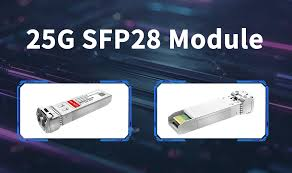
It uses single-mode fiber, which is already common in many deployments. The form factor typically fits into SFP28 ports, which are often backward compatible with 10G interfaces in newer hardware.
This compatibility allows upgrades to happen incrementally.
Instead of replacing entire sections of the network, engineers can focus on specific links. A congested connection gets upgraded to 25G, while others remain unchanged. Over time, more links can be upgraded as needed.
The network evolves gradually, rather than all at once.
That approach reduces both risk and operational impact.
What Makes It Feel Stable in Practice
Beyond the upgrade process itself, 25GBASE-LR also benefits from a relatively simple design.
Unlike some earlier multi-lane technologies, it operates over a single optical lane. That simplicity tends to translate into predictable behavior. There are fewer internal variables, and fewer chances for imbalance between channels.
In day-to-day operation, this shows up as stability.
Links come up quickly and remain consistent. Monitoring systems report standard metrics—optical power, temperature, interface statistics—and these values usually stay within expected ranges.
When issues occur, they’re often tied to physical factors like fiber quality or connector cleanliness, rather than complex internal interactions.
For operations teams, that predictability reduces troubleshooting time.
Where It Fits in Layered Network Designs
Modern networks are rarely uniform. Instead, they’re built in layers, each with different performance requirements.
Core layers handle large volumes of traffic and often move to higher speeds like 100G or beyond. Access layers connect end devices and may not require as much bandwidth. Aggregation layers sit somewhere in between.
25GBASE-LR fits particularly well in that middle layer.
It provides enough capacity to handle aggregated traffic without introducing the cost and complexity of higher-speed solutions. At the same time, it maintains compatibility with existing fiber infrastructure, making it easier to integrate into established designs.
This layered approach allows networks to balance performance and cost more effectively.
Why It Stays Relevant Even as Speeds Increase
Even as higher-speed technologies become more common, 25G doesn’t disappear.
Part of the reason is timing. Not every part of the network upgrades at the same pace. Some areas reach their limits earlier, while others remain stable for longer periods.
Another factor is efficiency.
If a 25G link is meeting current demand, upgrading it further may not provide a meaningful benefit. In those cases, it makes sense to leave it as it is and focus resources elsewhere.
As a result, 25GBASE-LR often becomes part of a long-term mixed environment, coexisting with both lower and higher-speed links.
A Practical Approach to Ongoing Growth
What makes 25GBASE-LR particularly useful is how well it supports gradual growth.
Instead of forcing a network-wide upgrade, it allows capacity to be added where it’s needed, when it’s needed. This aligns well with how most organizations actually operate—balancing technical requirements with budget constraints and operational considerations.
Over time, some of these links may be upgraded again. Others may remain at 25G for years.
The network evolves based on real demand, not just theoretical planning.
Conclusion
25GBASE-LR offers a practical solution for networks that need to scale capacity without introducing unnecessary complexity. By providing a clear step up from 10G while maintaining compatibility with existing single-mode fiber infrastructure, it supports incremental upgrades that align with real-world growth patterns. Its stable operation, simple deployment, and balanced performance make it well suited for aggregation and mid-layer connections, where measured improvements often deliver the most value.