How a Systematic CNC Milling Selection Framework Prevents Cost Traps and Saves 30% on Production Budgets
Introduction
In product development, engineers and project managers face a perplexing array of choices when selecting a CNC milling process: 3-axis, 4-axis, 5-axis, high-speed milling, multi-sided machining. A selection based on intuition or limited experience can lead to prototype costs far exceeding budgets, failure to achieve critical functions, or planting unreliable seeds for future mass production. This trial-and-error approach erodes project margins and delays time-to-market.
The core issue is treating “milling” as a single, universal solution rather than a highly parameterized decision tree. Traditional selection methods often consider machine capability in isolation, failing to systematically correlate part geometry, material behavior, quality requirements, production volume, and Total Cost of Ownership (TCO). This article proposes a three-dimensional decision framework that integrates “Geometric Complexity,” “Material & Quality,” and “Batch Economics” into a single visual model. The model aims to help teams move beyond the simplistic “3-axis vs. 5-axis” debate, using a data-driven method to identify the manufacturing path that is optimal for performance, cost, and time for each unique project.
Why Does a “Simple” Part Geometry Often Lead to Complex and Costly Machining Choices?
Part geometry is the primary driver of machining complexity, but this complexity is often misunderstood. A part that looks visually simple may contain hidden cost drivers like high-aspect-ratio pockets, thin-walled sections, or features on multiple sides. Misjudging these elements can lead to selecting a machine with insufficient capabilities (causing scrap and rework) or over-specifying an expensive process (wasting budget). A systematic assessment moves beyond subjective labels to quantify geometric demands, ensuring the chosen CNC milling process aligns precisely with the part’s true manufacturing challenges. Mapping design features to manufacturing processes systematically is foundational to optimizing decisions, as it transforms subjective judgment into an engineering analysis.
1. Decoding True Geometric Complexity Beyond Visual Appearance
Geometric complexity is not just about organic shapes. A flat plate with a grid of tapped holes is a 2.5D geometry, ideal for 3-axis milling. However, if that plate also has a deep, narrow slot, it becomes a challenge requiring a long tool, risking chatter. A part with compound angles or undercuts is a true 3D contour, mandating 4th or 5th-axis capabilities. Furthermore, a “simple” bracket with bosses and ribs on both sides transforms from a 2-sided part to one requiring multiple setups or a multi-axis machine. Failing to inventory all geometric features and their spatial relationships is the first step toward a costly mismatch in CNC milling type selection.To gain a deep understanding of how various milling processes address diverse geometric challenges, a comprehensive guide to custom CNC milling services offers a detailed roadmap ranging from basic classifications to advanced applications.
2. The Impact of Feature Interactions and Accessibility
Individual features are one thing; their interaction is another. A deep pocket located near a thin wall creates a dilemma: machining the pocket deep may weaken the wall, while supporting the wall may block tool access. Similarly, a blind hole with a flat bottom is easy, but if that hole must have a tight perpendicularity callout relative to a datum on the opposite side, it becomes a high-precision, multi-setup challenge. Analyzing these interactions determines whether a part can be made in one setup on a 5-axis machine (preserving accuracy) or requires several setups on a 3-axis machine (introducing error and handling time). This analysis is central to precision machining.
3. Quantifying Complexity to Justify Process Investment
The goal is to assign a quantitative or categorical “complexity score” to justify process investment. A part scoring high on metrics like number of unique setups required, presence of undercuts, or maximum depth-to-diameter ratio is a strong candidate for a multi-axis or high-speed machining center, despite a higher hourly rate. A low-complexity part, even if visually intricate, might be perfectly and economically served by a 3-axis machine with a clever fixture. This objective scoring prevents overspending on advanced technology for parts that don’t need it and underpays for the capabilities required by truly complex designs.
How Do Material Properties and Surface Integrity Requirements Dictate the “Allowed” Process Window?
The workpiece material and required surface integrity form a second, non-negotiable dimension of the selection framework. Material properties like hardness, thermal conductivity, and work-hardening tendency dictate the necessary machine rigidity, spindle power, and cooling strategy. Simultaneously, specifications for surface finish, dimensional tolerances, and residual stress determine the number of required operations (roughing, semi-finishing, finishing) and the precision level of the equipment. Choosing a process that cannot maintain the material’s integrity or achieve the specified quality renders the part functionally useless, regardless of geometric fit. The material’s inherent machinability fundamentally defines the viable process parameters, making material science data a critical input for scientific selection.
- Machine and Tooling Demands Driven by Material Science: Machining 6061 aluminum is fundamentally different from machining Inconel 718. Aluminum is soft and gummy, requiring sharp tools and high speeds, but it’s forgiving. Inconel is hard, abrasive, and retains heat, demanding a machine with extreme rigidity and thermal stability, high-pressure coolant, and specialized carbide or ceramic tooling. Selecting a standard 3-axis mill for a titanium aerospace bracket might be geometrically possible but economically disastrous due to extremely slow cutting speeds and rapid tool wear. The material dictates the minimum machine performance threshold, making material-matched process selection a prerequisite for cost control and feasibility.
- The Multi-Step Journey to Achieve Specified Quality: Quality requirements often necessitate a sequence of operations. A part requiring a mirror finish (Ra < 0.4 μm) cannot be achieved directly from a roughing operation. It will need progressive finishing passes with increasingly finer step-overs and potentially a separate bench polishing or electropolishing step. Tight geometric tolerances (like flatness or true position within 0.025 mm) require a machine with high positioning accuracy and repeatability, often found in higher-tier precision CNC milling centers. The framework must account for this “process ladder” — each additional quality step adds time, cost, and potentially requires a different machine or secondary process.
- Managing Thermal Effects and Residual Stresses: For many high-performance applications, the functional performance of the part depends on the subsurface condition, not just dimensions. Machining generates heat and mechanical stress, which can alter the material’s microstructure, leading to softening, recast layers, or tensile residual stresses that promote cracking. Controlling this requires processes that manage heat input, such as high-speed machining with light cuts or using specific tool paths. A standard process on an inadequate machine might produce a part that passes initial inspection but fails prematurely in service. Therefore, the selection must consider the part’s end-use environment and select a process capable of delivering the necessary material integrity.
What is the Real Cost Structure Behind a CNC Milling Quote: Machine Time, Setup, or Tooling?
Understanding the true cost drivers behind a CNC milling quote is essential for making economical decisions. The total cost is not simply “machine time x hourly rate.” It is a composite of non-recurring engineering (NRE) costs, setup and fixturing, per-piece machining time, tooling consumption, and overhead. The dominant cost factor shifts dramatically with order quantity. For a one-off prototype, programming and setup can constitute 80% of the cost. For a production run of 10,000, per-piece cycle time and tooling cost per part become the overriding concerns. Misunderstanding this cost structure leads to comparing “apples to oranges” when evaluating quotes and missing opportunities for significant savings.
1. The Dominance of NRE and Setup in Low-Volume Production
For prototypes and very low volumes (1-10 pieces), the cost is dominated by front-end engineering. This includes the time for a manufacturing engineer to analyze the CAD file, create the CAM program, and design any necessary custom fixtures. The actual machine time may be minor in comparison. A supplier with a highly efficient digital workflow and standardized fixturing systems can drastically reduce these NRE costs. This is why a rapid prototyping specialist, even with a higher machine rate, can often deliver a single part faster and cheaper than a high-volume production shop not geared for one-offs.
2. The Transition to Per-Piece Efficiency in Medium Batches
As quantities increase to the hundreds, the cost structure pivots. The one-time NRE is amortized over more parts. Now, the per-part cycle time becomes king. A machine that is 20% faster directly reduces the cost of every single unit. Additionally, tooling strategy becomes critical. Using a more expensive but longer-lasting tool may lower the cost-per-edge. The selection framework must now evaluate machines and processes not just on capability, but on throughput efficiency. A 5-axis machine that completes a part in one setup might have a faster total cycle time than a 3-axis machine requiring two setups, even with a higher hourly rate.
3. The Economics of Scale: Automation and Tooling in High Volume
For production runs in the thousands, the focus expands to sustained efficiency. This involves automated material handling, pallet changers to minimize machine idle time, and sophisticated tool life management systems to predict and schedule tool changes before they cause defects or downtime. At this scale, even a saving of 10 seconds per part translates to hundreds of hours of machine time saved. The selection decision often involves investing in dedicated fixtures or even custom tooling to shave seconds off the cycle time. The CNC milling cost analysis must now account for the total cost of ownership over the entire production lifecycle, not just the first batch.
How Can a “Complexity vs. Volume” Matrix Visualize the Optimal Manufacturing Path?
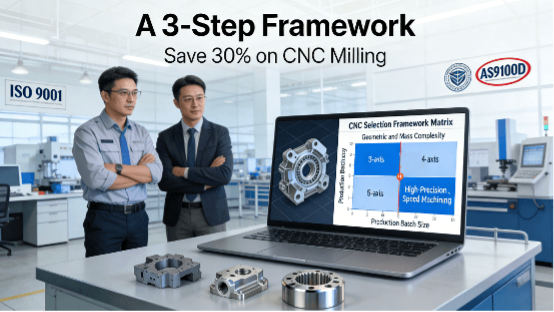
The core of the selection framework is a two-dimensional decision matrix that plots “Geometric & Quality Complexity” on the Y-axis against “Production Volume” on the X-axis. This matrix creates distinct zones where different CNC milling applications and technologies are economically optimal. A high-complexity, low-volume medical implant prototype falls in the “5-axis machining” zone. A low-complexity, high-volume automotive pin belongs in the “3-axis with dedicated automation” zone. This tool transforms abstract comparisons into a clear, visual strategy, enabling teams to quickly identify the target process and have informed discussions with suppliers. Understanding the economics of scale and complexity is vital for this strategic mapping.
1. Defining the Zones: From Prototyping to Mass Production
The matrix typically features four quadrants. The Low Complexity / Low Volume quadrant is the domain of standard 3-axis milling and online machining services for fast, cost-effective prototypes. The High Complexity / Low Volume quadrant is where 5-axis machining and 3+2-axis indexed milling shine, adding the flexibility needed for complex one-offs without the cost of hard tooling. The Low Complexity / High Volume quadrant favors high-speed 3-axis machining with optimized fixtures, and potentially automation. The High Complexity / High Volume quadrant is the most challenging, often requiring dedicated 5-axis production cells or a hybrid approach combining different technologies.
2. Applying the Matrix to Common Project Scenarios
Consider a drone arm bracket made from carbon fiber composite (moderate complexity, medium volume). The matrix might point to 4-axis or 5-axis machining to handle the contours and ensure strength, but with a focus on process optimization for the batch size. Contrast this with an aluminum heat sink (low complexity, very high volume). Here, the matrix directs toward multi-spindle 3-axis machines or high-speed machining centers with automatic pallet changers to maximize output. Using the matrix prevents the common error of specifying a 5-axis process for a high-volume, simple part, which would bury the project in unsustainable costs.
3. Using the Matrix for Supplier Evaluation and RFQ Strategy
The matrix is also a powerful tool for engaging suppliers. Instead of sending a generic RFQ to ten different shops, you can target suppliers who specialize in the quadrant your project occupies. When discussing with a CNC milling manufacturer, you can reference the matrix: “Our part is here, in the medium-complexity, medium-volume zone. What is your recommended process and how do you optimize costs for this profile?” This demonstrates strategic thinking and leads to more valuable, tailored proposals rather than generic quotes, ultimately leading to better custom manufacturing outcomes.
From Medical Device Housings to Aerospace Brackets: How Does the Framework Apply in Practice?
Practical case studies demonstrate the framework’s power to drive optimal outcomes. Consider a medical device housing that must be liquid-tight, biocompatible, and include internal snap-fits. Initial attempts used 3-axis machining of multiple parts followed by ultrasonic welding — a process prone to leaks. Applying the framework revealed a high-complexity, medium-volume profile. The solution was a switch to 5-axis machining of a single, monolithic part from PEEK, eliminating assembly, guaranteeing seal integrity, and improving sterilization capability, validating the 5-axis investment through superior reliability and lower total assembly cost.
1. Case Study 1: High-Complexity, Medium-Volume Medical Housing
The challenge was a handheld surgical tool housing with intricate internal channels for fluidics and mounting features for PCBs. Traditional multi-part assembly was unreliable. The framework placed it firmly in the high-complexity/medium-volume quadrant. The selected partner used simultaneous 5-axis machining to create the housing as one piece from medical-grade plastic. This eliminated assembly, reduced part count by 70%, and ensured perfect alignment of internal features. While the per-part machining cost was higher, the total cost (machining + assembly + testing + risk of failure) decreased by over 25%, and product reliability soared.
2. Case Study 2: Low-Complexity, High-Volume Automotive Bracket
Conversely, an automotive engine bracket was a simple, prismatic aluminum part, but required in volumes of 50,000+ annually. The framework placed it in the low-complexity/high-volume quadrant. Here, investing in a custom multi-cavity fixture for a high-speed 3-axis machining center was the key. This allowed multiple parts to be machined in a single cycle. The process was optimized for minimum cycle time and maximum tool life. The focus was on automation integration and statistical process control (SPC) to maintain quality. The result was a per-part cost that was a fraction of what a 5-axis machine could achieve, perfectly aligning process capability with product economics.
3. Extracting Universal Principles from the Case Studies
The two cases highlight universal principles. First, total cost trumps piece-part cost. The medical housing saved money overall by eliminating downstream assembly and risk. Second, the optimal process is volume-dependent. The same bracket geometry might be 5-axis machined for a 10-piece prototype (where setup cost dominates) but must be 3-axis mass-produced for 50,000 pieces. Finally, success depends on partner capability. The medical case required deep 5-axis and bio-compatible material expertise; the automotive case required high-volume production engineering and quality control. The framework guides you to seek the right partner for your specific quadrant.
What Capabilities Should You Seek in a Partner to Execute This Optimized Strategy?
Executing a strategy derived from the selection framework requires a manufacturing partner with specific systemic capabilities, not just a machine list. The ideal partner can provide data-driven DFM analysis to validate your complexity assessment, possesses a flexible technology portfolio (3-axis to 5-axis) to match the recommended process without bias, and operates within a certified quality management system (like ISO 9001) to ensure consistency from prototype to production. They should act as a collaborative engineer, helping to refine the strategy rather than just quoting a print. Ultimately, realizing the framework’s promise of cost control and performance relies on a partner capable of delivering integrated solutions. Therefore, the key is selecting a partner with the technical breadth and engineering depth to implement the optimized strategy. A supplier whose service combines multi-axis capabilities, in-depth engineering, and transparent cost management is essential for success.
- Technical Breadth and Objective Process Recommendation: A valuable partner has a range of capabilities and the objectivity to recommend the simplest, most cost-effective process that meets all requirements. They should be able to say, “For this volume, a 4-axis indexed approach is more economical than full 5-axis,” or “This feature can be redesigned for 3-axis machining, saving 30%.” Their shop should have both high-speed 3-axis mills for efficiency and 5-axis centers for complexity, preventing a one-size-fits-all approach. This breadth allows them to place your project in the correct quadrant of the selection matrix and execute accordingly.
- Depth of Engineering Collaboration and Proactive DFM: The partnership must extend beyond order-taking. Look for a partner that provides proactive, detailed DFM reports as part of the quoting process. Their engineers should engage in a technical dialogue, suggesting material alternatives, tolerance relaxations, and feature modifications that align with your target cost and volume. This collaborative engineering is how the theoretical framework is pressure-tested and refined for real-world production. A partner invested in making your part manufacturable and cost-effective is a partner invested in your success, distinguishing a true custom CNC milling supplier from a job shop.
- Quality Systems and Scalable Project Management: Finally, the partner must have the operational maturity to deliver. A certified Quality Management System (QMS) like ISO 9001:2015 provides the framework for consistent processes, corrective action, and traceability — critical for any volume. Their project management should be transparent, with clear communication on timelines and milestones. They should demonstrate experience in scaling from prototyping to production, ensuring that the process validated for 10 parts is robust enough for 10,000. This combination of technical capability, engineering collaboration, and systematic operation is what defines a partner capable of being a reliable extension of your manufacturing team.
Conclusion
Selecting the right CNC milling process should not be a linear choice based on machine specifications, but a systematic optimization based on a project’s multidimensional constraints: geometry, material, quality, and volume. By adopting a structured decision framework — centered on a complexity-versus-volume matrix — engineering and procurement teams can transform manufacturing selection from a realm of fuzzy experience into a domain of clear, data-driven strategy. This disciplined approach prevents budget overruns, unlocks optimal part performance, and forges collaborative partnerships that turn manufacturing from a cost center into a source of competitive advantage and predictable project success.
FAQs
Q: How do I decide between 3-axis and 5-axis CNC milling for my part?
A: The choice hinges on part geometry and required accuracy. Use 3-axis milling for prismatic parts where all features are accessible from the top. Choose 5-axis milling for parts with complex 3D contours, undercuts, or multi-sided features that would require repositioning in a 3-axis machine. 5-axis allows single-setup machining, improving accuracy on interconnected features and surface finish, but at a higher hourly rate.
Q: What are the most effective ways to reduce the cost of CNC milled parts?
A: Key strategies include Design Simplification (minimize deep pockets, tiny features), Material Selection (use cost-effective grades that meet requirements), Tolerance Rationalization (apply tight tolerances only where critical), and Batch Optimization to amortize setup costs. The most impactful step is early Design for Manufacturability (DFM) feedback from your manufacturer to identify hidden cost drivers.
Q: What factors most significantly impact the lead time for CNC machined parts?
A: Lead time is driven by part complexity (3-axis vs. 5-axis), material availability (standard vs. exotic), shop workload, and required post-processing (e.g., anodizing). For standard parts, the bottleneck is often machine scheduling. Providing complete, clear CAD files and drawings upfront eliminates quote delays and allows for faster project scheduling with a capable supplier.
Q: What file format and information are needed for an accurate CNC milling quote?
A: Provide a 3D CAD model in a neutral solid format like STEP (.stp) for geometry analysis. Also include a detailed 2D PDF drawing specifying all dimensions, tolerances (GD&T), material, and surface finishes. Complete, unambiguous information minimizes back-and-forth, enabling a faster and more accurate quote.
Q: How is quality assured for precision CNC milled components, especially in production runs?
A: Quality is assured through a multi-layered system: First Article Inspection (FAI) with CMMs validates the part against the CAD model. For production, Statistical Process Control (SPC) monitors key dimensions. The entire process is underpinned by a certified Quality Management System (QMS) like ISO 9001, ensuring standardized procedures, full traceability, and consistency from the first part to the last.
Author Bio
The author is a specialist in precision CNC manufacturing and process planning, with over 12 years of experience helping clients solve complex cost and performance optimization challenges through systematic analysis. Their expertise is applied within the framework of LS Manufacturing, a precision engineering partner dedicated to providing end-to-end manufacturing solutions from rapid prototyping to volume production. The team operates under a certified management system encompassing ISO 9001, IATF 16949, and AS9100D, ensuring systematic quality and traceability. For a professional manufacturability and cost optimization analysis for your new project, explore their comprehensive CNC milling capabilities and submit your CAD files for a customized engineering report and transparent quote.