The Cost Benefits of Human-Assisted Robotics Support
As robotics technology becomes more advanced, businesses across industries are deploying autonomous systems to improve efficiency and reduce manual workloads. From delivery robots and warehouse automation to security patrol robots and hospitality assistants, robotic solutions are helping organizations streamline operations and scale services.
However, fully autonomous robots are not always capable of handling every real-world situation independently. Unexpected obstacles, environmental changes, and customer interactions often require human judgment and intervention. This is why many robotics companies adopt human-assisted robotics support as part of their operational strategy.
By combining automation with remote human oversight, organizations can reduce costs, improve efficiency, and maximize the value of their robotics investments.
What Is Human-Assisted Robotics Support?
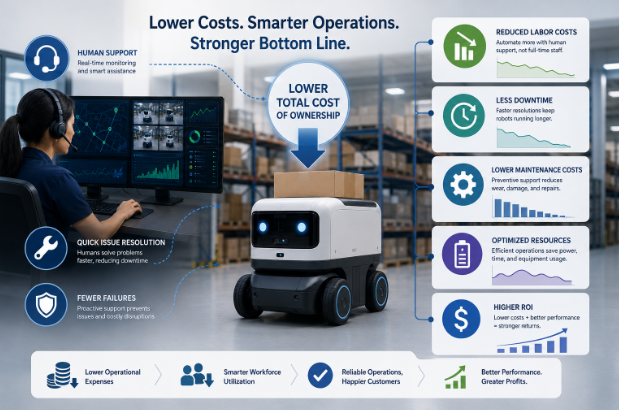
Human-assisted robotics support refers to a model where autonomous robots perform routine tasks independently, while trained remote operators assist when needed.
Rather than assigning an on-site employee to every robot, organizations use centralized support teams that can monitor multiple robots simultaneously.
These operators may:
Monitor robot activity
Review camera and sensor data
Respond to alerts
Assist with navigation challenges
Escalate operational issues
Support customer interactions
This human-in-the-loop approach helps maintain reliable operations without requiring constant direct control.
Reducing On-Site Staffing Costs
One of the most significant advantages of human-assisted robotics support is the reduction in staffing requirements.
Without remote support, organizations may need to assign employees at every deployment location to assist robots when problems occur. This can become costly as robot fleets expand.
Human-assisted support helps businesses:
Minimize on-site labor costs
Reduce operational overhead
Centralize support functions
Improve workforce utilization
A remote operations model allows companies to support larger deployments with fewer resources.
Supporting Multiple Robots with Fewer Operators
A single remote operator can often supervise multiple robots simultaneously, depending on the deployment and operational requirements.
This creates substantial cost efficiencies by:
Reducing personnel requirements
Lowering operational expenses
Improving scalability
Maximizing support coverage
Instead of hiring one employee per robot, organizations can build centralized support teams that monitor entire fleets.
Minimizing Downtime and Operational Losses
Robot downtime can be expensive. Delays, interruptions, and service failures can impact productivity, customer satisfaction, and business performance.
Human-assisted robotics support helps reduce downtime by allowing operators to:
Respond quickly to alerts
Resolve navigation issues
Assist robots during exceptions
Restore operations faster
Keeping robots active and productive helps maximize return on investment.
Improving Scalability Without Significant Cost Increases
As organizations deploy more robots, support requirements naturally grow. However, expanding support teams at the same pace as robot deployments may not be financially practical.
Human-assisted support provides a scalable solution by allowing businesses to:
Add robots without proportionally increasing staffing
Centralize operations management
Maintain consistent service quality
Expand deployments efficiently
This flexibility is particularly valuable for fast-growing robotics companies.
Reducing Training and Infrastructure Expenses
Building local support teams often requires office space, equipment, training programs, and management resources.
Remote support models help reduce these costs by:
Centralizing operator training
Standardizing operational procedures
Reducing infrastructure requirements
Improving workforce management
Organizations can achieve greater efficiency while maintaining high support standards.
Enhancing Operational Reliability
Unexpected operational issues can result in lost productivity and increased service costs. Human-assisted robotics support helps improve reliability by ensuring robots receive assistance when autonomous systems encounter challenges.
Benefits include:
More consistent performance
Improved service continuity
Faster incident response
Better customer experiences
Reliable operations help businesses avoid costly disruptions.
Supporting Long-Term Robotics Adoption
Many organizations hesitate to deploy large robotic fleets because of concerns about support requirements and operational complexity. Human-assisted support helps address these concerns by providing a practical framework for managing robots at scale.
Businesses can confidently expand automation initiatives while maintaining operational control and cost efficiency.
Why Businesses Invest in Robot Teleoperation & Robot Monitoring
Many robotics companies utilize professional Robot Teleoperation & Robot Monitoring services to provide cost-effective human oversight for autonomous systems. Dedicated remote operators monitor robot activity, assist with navigation challenges, respond to alerts, and support large-scale robotic deployments across multiple industries.
Professional support services help organizations reduce costs while improving reliability, scalability, and operational performance.
The Future of Cost-Efficient Robotics Operations
As robotics adoption continues to grow, businesses will increasingly look for ways to balance automation with practical operational support. Human-assisted robotics provides a cost-effective model that combines the efficiency of autonomous systems with the flexibility of human decision-making.
This approach enables organizations to maximize automation investments while controlling operational expenses.
Conclusion
Human-assisted robotics support offers significant cost benefits for organizations deploying autonomous systems. By reducing staffing requirements, minimizing downtime, improving scalability, and centralizing support functions, businesses can operate robotic fleets more efficiently and economically.
For companies seeking a reliable and scalable approach to robotics operations, professional Robot Teleoperation & Robot Monitoring services provide the human oversight needed to support successful deployments while keeping operational costs under control.