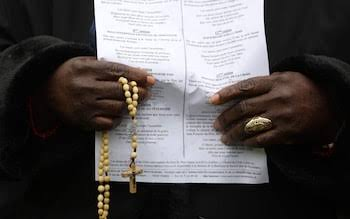
Why are more young Catholics rediscovering the rosary today?
This photo was sent to me by my 24 year old cousin (a tech worker who loves hyperpop music). She confessed that she does not know why she’s doing this but that it helps her.
Honestly, that’s probably the most truthful thing anyone has said about the rosary in years.
Something is shifting, and it’s not what you’d expect
The standard story about young people and religion runs in one direction only: they’re leaving
Most people associate young adults with a certain kind of disaffection from the church, a disaffection reported in the media over and over again. The ‘nones’ are reported to be growing in numbers and the declining number of parishes is reported as if it were a disaster. There are, however, certain ways in which young adults are engaging with the faith in meaningful ways. They join a young adult group on campus, for example, and practice traditional devotional practices such as praying the rosary.
Perhaps, after further examination, it will become apparent to people why young Catholics are flocking to videos on TikTok of people praying the rosary.
The pace of today’s information world is one of constant distraction and can be incredibly stressful. To cope with the overwhelming torrent of information and to find their own space and rhythm, many young people today are trying to find ways of living at a slower pace. And this is where the rosary, with its slow, methodical and deliberate repetition, becomes an incredibly powerful tool for the young Catholic today. The rosary asks the user to live at a pace which is completely contrary to that of the information stream around them – and to engage fully in that repetition in order to enter fully into the prayer itself.
The authenticity problem haunting modern spirituality
A lot of “spirituality” today is packaged up and sold as a wellness product. In a world where people are constantly looking for modern approaches to personal growth and development, many are also becoming more aware of the importance of practices that offer genuine meaning rather than temporary trends. Often this can be really good for people who are searching for meaning, but there is a lot of inauthentic spirituality around that has been rebranded from old spiritual practices in order to make a buck. This is the root of a lot of the suspicion that young Catholics have of a lot of contemporary spirituality.
This is a practice that does not have a price tag, a medium that is not commercialized. A rosary is not something that you can pick up off of the shelf at a local religious store and it is not something that you can download to your phone. A rosary is a physical object, it is a collection of beads that have been used for centuries by peasants and by queens, by soldiers and by the dying. It has been used by the most grief stricken and by the most hopeful of people. And the practice of praying the rosary has been passed down from generation to generation.
What draws young adults to Catholic devotional practice is that they ask something of you. They are often in opposition to what are typically referred to as “frictionless” spiritual practices and require the participation of the believer. In this sense, young adults are drawn to them precisely because they are not neutral, because they involve discipline and because they require you to show up to them.
Complicating the above by acknowledging the medium is part of the message.
Type of young Catholic
What tends to draw them to the rosary
How they typically engage
Cradle Catholic returning to faith
Familiarity, memory, the pull of family tradition
Solo, often late at night before sleep
Convert or revert in early 20s
Theological depth, structure, something to hold onto
Structured daily practice, often with guides or podcasts
Someone exploring contemplative spirituality
Meditative rhythm, deliberate stillness, the slow pace
Unhurried and reflective, sometimes alongside journaling
Community-oriented young adult
Shared practice, group prayer, belonging to something larger
Group rosary, young adult ministry, parish events
But then there is the fact that something that has been true for centuries is being found by young people in the midst of all of the modern media that is currently being inundated into their lives. Here is something to think about – something that is true for all time (centuries old) is being communicated to and found by people in the midst of the most modern of mediums (YouTube, Instagram, etc.). Something that is good, true, and beautiful can be used by anyone at any time – and so here is a valuable treasure that is being passed down to young people today in the midst of all of their information consumption.
The social dimension nobody talks about enough
However, the rosary is a very communal practice. It is often practiced by families or within a group of friends. There are many young adults who join a Catholic group on campus, only to find that they have more in common with fellow group members than they expected. Seeing someone of the same age as you take tradition seriously and not be embarrassed by it is very powerful and can have a lot of different effects on a person.
It is rather impressive to see someone your own age treating old devotions seriously and without embarrassment. This can give quite a lot of permission to others to explore practices of this nature.
There are a lot of new rosaries being made specifically for young adults, but a lot of people are also reverting back to the same kind of rosaries that their grandmothers used to pray with. There are a wide variety of rosaries, made with all sorts of different materials. Some people like to pray with wooden beads, others with crystal, others with metal beads, and there are also rosaries made with a knotted cord. I recently came across a great website called rosaries that has a huge collection of rosaries from all around the world. As a young adult, I think it is great that I can browse through all of the different kinds of rosaries that are available and find one that I like and that fits me well. I think that just choosing a rosary is already an act of devotion.
What the critics consistently miss
There are many who are labeling this a return to old devotions due to nostalgia. While it is true that many of the devotions being drawn back to are old, this does not mean they are childish. And while it is true that many of these devotions can be simple-minded, that is not true for all of them. And lastly, while it is true that many young Catholics are returning to old devotions, this does not mean that they are returning to the past. They are returning to old devotions in a new way.
As a result, these Catholics are not practicing in order to escape the difficult questions that faith and doubt pose. Rather, they are practicing in order to be able to live through the tensions and contradictions that mark out their lives. Their practice of the rosary does not resolve their doubts about God’s existence or will. Rather, it makes it possible for them to live through those doubts on a daily basis. The rosary, in short, helps them to live through the tension of their faith.
A quick look at what’s drawing different groups in
| Type of young Catholic | What tends to draw them to the rosary | How they typically engage |
| Cradle Catholic returning to faith | Familiarity, memory, the pull of family tradition | Solo, often late at night before sleep |
| Convert or revert in early 20s | Theological depth, structure, something to hold onto | Structured daily practice, often with guides or podcasts |
| Someone exploring contemplative spirituality | Meditative rhythm, deliberate stillness, the slow pace | Unhurried and reflective, sometimes alongside journaling |
| Community-oriented young adult | Shared practice, group prayer, belonging to something larger | Group rosary, young adult ministry, parish events |
There is no one type of young Catholic, and that’s probably what this piece is trying to get at. Other pieces have attempted to explain what young people of this generation want from their religion and failed, falling back on the term “generational” to categorize young people today.
It probably won’t look like their grandparents’ rosary
Fine. More than fine, actually. The form carries meaning across centuries,
This practice is old – hundreds of years old. However, the way that every generation lives out this practice will be different from every other generation. Just because the rosary is an old practice does not mean that it has to be lived out in an old way. In fact, I have found that young Catholics are very open to practicing their faith in a variety of new ways. The rosary is a part of the old ways of practicing our faith and, for many young Catholics, this is a great practice to add to their already active and diverse way of living out their faith. They will bring their unique perspectives, questions, and struggles to this ancient practice. They will pray the rosary with all of their doubts and distractions. They will even half-pray it at times, falling asleep somewhere in the middle and continuing the rest of the way a few days later. And, yes, at times they will even get bored with it and stop for a while. But, the rosary is a very patient practice. It will hold their half-way praying and even their boredom.
I remember my cousin telling me a few months ago that she’s been saying the rosary. Sometimes she manages to complete the entire 5 decades. Other times she falls asleep somewhere around the 2nd. But every time she comes back to it. She still can’t quite explain why.
This is the story of young Catholics and the rosary.