CrowdStrike EDR for Small Businesses: Why It’s an Essential Security Tool
Small businesses carry more risk than most of their owners realize. The assumption that sophisticated attackers only go after large enterprises has been demonstrably wrong for years — and acting on it leaves organizations exposed to threats they’re genuinely unprepared for. Limited IT staff, lean security budgets, and valuable customer and financial data make smaller companies an attractive target for ransomware groups, credential theft operations, and persistent intrusion campaigns.
The gap isn’t in awareness anymore — most small business leaders understand cybersecurity matters. The gap is in tooling. Standard antivirus products weren’t built for the threats that dominate today’s landscape, and CrowdStrike EDR was.
Built on the cloud-native Falcon platform, it delivers the kind of endpoint detection and response capability that was once exclusive to enterprise security teams, without the infrastructure overhead that historically made it inaccessible to smaller organizations.
Why Legacy Antivirus Leaves Small Businesses Exposed
Signature-based antivirus operates on a simple premise: compare files against a database of known malware, and block what matches. For threats that have already been catalogued, it works. For everything else — which increasingly means the threats that actually cause damage — it doesn’t.
The techniques that define modern attacks are specifically designed to sidestep signature detection:
- Fileless malware runs entirely in memory, never writing a file to disk that a scanner could flag
- Living-off-the-land (LOTL) attacks abuse legitimate Windows utilities — PowerShell, WMI, certutil — to carry out malicious actions using tools the OS itself provides
- Zero-day exploits target vulnerabilities before any patch or detection signature exists
- Slow-burn intrusions involve attackers who move patiently through a network for days or weeks before triggering any visible action
None of these generates a traditional antivirus alert. CISA’s Cyber Guidance for Small Businesses is explicit on this point — the security landscape has shifted, and advice built around legacy tools no longer reflects the actual threat environment smaller organizations face.
What Is CrowdStrike EDR and How It Works
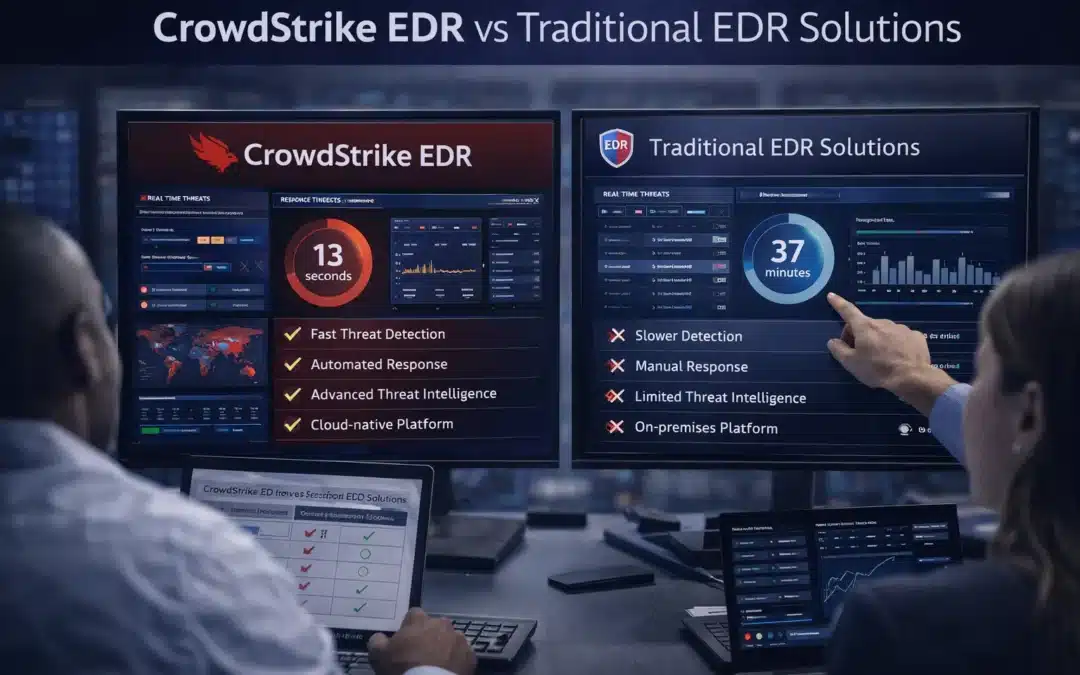
CrowdStrike EDR is the endpoint detection and response layer of the Falcon platform. A single lightweight agent installs on each endpoint — laptops, workstations, servers — and streams granular behavioral telemetry to CrowdStrike’s cloud in real time. That data feeds into AI-powered detection models trained on threat intelligence drawn from CrowdStrike’s global sensor network.
The detection logic doesn’t rely on matching files against known signatures. It watches behavior: what processes do, how they interact with the operating system, what network connections they open, and whether those patterns fit the profile of malicious activity — including activity that has never been seen before.
Continuous Endpoint Monitoring
The Falcon agent runs quietly in the background, capturing a complete record of endpoint activity without disrupting normal operations. Every process creation, registry modification, file write, and network connection is logged with context — which user account triggered it, what parent process spawned it, what happened immediately before and after.
This continuous data stream is what makes retrospective investigation possible. When an incident occurs, the timeline is already built.
Behavioral Analysis and AI-Driven Detection
Raw telemetry gets value through analysis. The platform applies both rule-based detection — flagging known-bad patterns like a document application spawning a command shell — and behavioral modeling that surfaces anomalies no rule would catch. A service account that suddenly starts querying Active Directory at 2 a.m., or a process that opens a network socket it has never used, stands out against its own behavioral baseline.
The AI layer continuously learns from new threat data, which means detection coverage improves without manual rule updates on the customer’s side.
Automated Response Without Waiting for Human Intervention
When a confirmed threat is detected, the platform doesn’t just alert — it can act. Compromised endpoints can be isolated from the network automatically, malicious processes terminated, and forensic snapshots collected, all without waiting for an analyst to respond.
For small businesses without around-the-clock security staff, this automated containment is one of the most practically significant capabilities the platform provides.
CrowdStrike EDR Features and Capabilities Worth Knowing
Next-Generation Antivirus Included
The Falcon platform incorporates NGAV alongside EDR, replacing legacy antivirus rather than layering on top of it. Smaller organizations benefit practically: one lightweight agent handles both prevention and behavioral detection, eliminating the cost and complexity of managing multiple endpoint security products. The NGAV component uses machine learning models — not signature databases — so it catches new malware variants without requiring constant definition updates.
Full Forensic Timeline for Every Endpoint
Every event the Falcon agent records is retained and searchable. After an incident, security teams can reconstruct a complete attack timeline — the exact process that initiated the intrusion, what credentials were accessed, which files were touched, and where the attacker attempted to move. That forensic depth dramatically reduces investigation time, which directly affects how quickly an organization recovers and resumes normal operations.
Traditional antivirus software provides none of this. When it fails to prevent an attack, there’s little visibility into what actually happened or how far it spread.
Managed Threat Hunting via Falcon OverWatch
CrowdStrike’s Falcon OverWatch service pairs the platform with a team of analysts who proactively hunt for attacker activity that hasn’t triggered automated alerts. This includes subtle indicators of a hands-on-keyboard intrusion — deliberate, low-volume activity by skilled attackers who understand how to move below the noise threshold of automated systems.
For small businesses that can’t employ dedicated threat hunters, OverWatch provides access to a proactive detection capability that would otherwise require a fully staffed SOC.
CrowdStrike EDR Solution: Practical Fit for Small Businesses
Cloud-Native Deployment With Minimal IT Overhead
One of the persistent objections to enterprise security platforms from smaller organizations is operational complexity. CrowdStrike’s architecture addresses this directly. The Falcon agent deploys in minutes across endpoints without requiring on-premises servers, hardware investments, or extensive configuration work for a company without a dedicated IT department, which matters considerably.
Platform updates, new detection logic, and threat intelligence improvements roll out automatically from the cloud. There’s no manual patching cycle for the security tool itself.
Tiered Packages That Scale With Organizational Needs
The Falcon platform offers modular packages that allow smaller organizations to start with core EDR and NGAV capabilities, then add components — identity protection, device control, managed threat hunting — as their security posture and operational capacity develop. This avoids the common problem of purchasing capabilities a lean team can’t yet use effectively.
Integration With Existing Security Infrastructure
CrowdStrike EDR integrates with SIEM platforms, SOAR tools, and identity security solutions. Organizations that already have some security infrastructure in place can route Falcon detections into existing monitoring workflows and trigger response playbooks automatically based on CrowdStrike alerts — rather than rebuilding their security stack from scratch.
Why Managed CrowdStrike EDR Makes Sense for Most Small Teams
| Approach | Internal Requirement | Best Fit |
| Self-managed EDR | Dedicated analyst(s), 24/7 coverage | Organizations with mature security teams |
| Managed CrowdStrike EDR | Minimal — provider handles operations | Teams without a dedicated SOC |
| Full MDR with CrowdStrike | Strategic oversight only | Complete outsourcing of detection and response |
Deploying the Falcon platform is the straightforward part. Extracting meaningful value from it — monitoring alerts continuously, triaging detections, investigating confirmed threats, and containing active incidents — requires skilled security professionals operating around the clock. Most small businesses don’t have that capacity internally, and a capable EDR platform with no one reviewing its output provides only marginal protection.
This is exactly why organizations working with CrowdStrike EDR through a managed detection and response provider get substantially more from the investment. Security professionals handle the monitoring, triage, and response functions on behalf of the client, using the Falcon platform as their primary visibility layer — delivering enterprise-grade protection without requiring the client to build or staff a SOC.
Questions to Work Through Before Deploying
Before rolling out any EDR platform, small business leaders should pressure-test their readiness with a few practical questions:
- Who monitors alerts? If there’s no dedicated answer to this, a managed service is the more realistic path than self-operation.
- Which endpoints are the highest priority? Servers, privileged workstations, and remote employee devices typically come first.
- What compliance requirements apply? HIPAA, PCI DSS, and similar frameworks include specific endpoint monitoring requirements that CrowdStrike EDR directly supports.
- Does EDR replace existing antivirus or run alongside it? Running both creates redundancy and performance overhead; the Falcon platform is designed to replace legacy AV entirely.
- What happens after a detection? The EDR identifies threats — but there needs to be a defined process for what the response looks like and who owns it.
CISA’s Cyber Essentials guide recommends that small organizations establish a clear incident response plan before deploying new security tools — a practical point that applies directly here. Detection without response is an incomplete program.
Building Endpoint Security That Matches the Actual Threat
Small businesses face the same threat actors as large enterprises, often with a fraction of the resources available to defend against them. CrowdStrike EDR closes that gap by delivering behavioral detection, automated containment, and deep endpoint visibility through a platform designed to operate effectively without requiring a large internal team.
The right operational model — whether self-managed or through a managed provider — determines whether that capability translates into actual protection or sits underutilized. For most smaller organizations, a managed approach converts the Falcon platform from a sophisticated tool into a continuously active defense.