Get Quieter Door Operation With a Properly Aligned Garage Door Track
The garage door should open and close at a steady, controlled rate without rattling, scraping, or grinding noises. Unusual noise doesn’t always come from the opener or the door panels. The track system is a big part of it, as it defines the route of the rollers during the opening and closing cycle.
With the track properly aligned, the door sections will move through vertical, curved, and horizontal positions with no undue resistance. Even a well-built door may vibrate, move unevenly, and wear out early if alignment is bad. Knowing how alignment impacts operation helps you to keep a quieter and more reliable sectional door system.
1. Why Track Alignment Influences Door Noise
The smoothness of each door panel’s motion relies upon the relationship between the rollers and tracks. When a track is mounted too near, too far, or is tilted or unevenly mounted, the rollers may be forced against the track sides rather than rolling through the desired path.
The garage door tracks need to have the same geometry throughout the vertical, transition, and horizontal sections of the track. Minor misalignments may be more apparent as the door is translated through these various positions.
Common sources of unwanted operating noise include:
- Roller-to-track contact caused by improper spacing or positioning.
- Track sections that do not meet smoothly at their connections.
- Loose mounting hardware that allows vibration during movement.
- Bent sections that interfere with consistent roller travel.
- Uneven installation that causes the door to shift during operation.
Reducing these issues can make the door movement noticeably smoother while reducing unnecessary mechanical stress.
2. Understanding the Role of Vertical and Horizontal Tracks
A sectional garage door uses numerous track sections as opposed to a single continuous track. The vertical tracks move the door up from the closed position; the curved and horizontal tracks move the panels up overhead.
All of the sections should be integrated into a single pathway. The vertical tracks can be unevenly set, causing the door to go into the curved transition at different places. Similarly, horizontal tracks that are not correctly aligned can impact the rollers’ ability to support the door when it is in the overhead position.
Precision is important because the rollers must have enough clearance to be able to roll freely with minimum side contact. The track should lead rather than push the rollers through the track. This is very important when diagnosing noise that only occurs during a portion of the door cycle.
3. Key Alignment Points for Quieter Operation
Track alignment is not just a case of making the rails look parallel. Care must be taken when installing with respect to the mounting position, spacing, connection points, and the path of the door.
Important Areas to Check:
- Vertical positioning: Keep the vertical tracks properly positioned relative to the door and jambs.
- Track spacing: Maintain appropriate spacing so rollers can travel without excessive side pressure.
- Curved transitions: Ensure the transition between vertical and horizontal sections is smooth and consistent.
- Horizontal positioning: Support the overhead tracks correctly so they remain stable during repeated movement.
- Fastener security: Tighten mounting hardware appropriately to prevent unnecessary vibration.
If the track system is designed to be assembled in the same manner every time, pre-punched mounting holes can also help with installation and adjustment. A jamb bracket that is set up correctly will ensure that the vertical track will stay where it is supposed to as the door is cycled repeatedly.
4. Material Quality and Track Stability
Materials, especially track materials, influence the ability of the system to keep its shape when it is used. Sectional door tracks are often made from galvanized steel, which has a high level of resistance to corrosion and is extremely rigid.
The correct formed steel track should have the desired profile and maintain it while operating. If the deformation becomes too great, it will alter the clearance of the rollers and create unwanted contact points. Corrosion protection is also important, as deterioration around mounting areas can eventually lead to loss of stability.
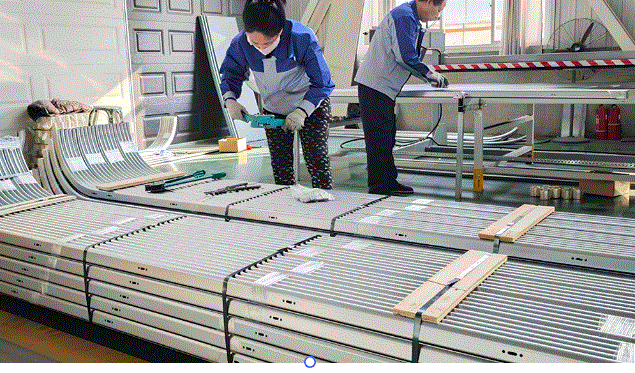
Another major benefit of precision roll forming is consistency. Forming is consistent to ensure the dimensions and geometry needed throughout vertical, curved, and horizontal track sections. In the residential and commercial markets, Gemax manufactures galvanized sectional-door tracks in various thicknesses, lengths, and configurations for a wide range of installation needs.
5. Installation Practices That Help Control Vibration
Even the best track can create noise if it’s not installed properly. Track sections must be fastened securely, and brackets and fasteners must ensure a firm hold without bending the track.
The door should also be checked after it has been installed, not after all of the hardware has been tightened, to ensure that the alignment is correct. Open and close the door gently and check if the rollers are always in the proper position in the tracks.
Practical Alignment Checks:
- Check that both vertical tracks are in the same position.
- Check for any sudden changes in the joints between track sections.
- Look for any signs of bending, denting, or twisted edges.
- Be aware of any abnormal movement of the rollers when opening and closing.
- Check to see that mounting brackets are secure.
- Listen for a sound at a particular point in a journey.
Such observations can be used to determine if the problem is an alignment issue or if noise is coming from another source, such as worn rollers, hinges, bearings, or the door operator.
6. Alignment Also Protects Other Door Components
This is just one advantage of proper track geometry. If a roller is repeatedly subjected to resistance, forces generated by the resistance can impact other moving parts.
Too much friction can lead to greater stress on the rollers, hinges, brackets, and other hardware involved. Also, if the travel is not even, the door may feel heavier or unbalanced when operating. Repeated abnormal contact over time can cause increased wear and maintenance more frequently.
Thus, the whole door assembly is supported with a stable track system. It provides a predictable path for the rollers and assists panels in changing from a vertical to overhead position.
7. Choosing Tracks for Different Door Configurations
Not all sectional doors are on the same track system. Track dimensions and track layouts may vary depending on the type of door (standard residential, commercial, low-headroom, etc.).
The height, radius, thickness, and mounting arrangement of the track should correspond to the door design. The standard options can meet common door heights, and the customized options can meet the special requirements of the OEM.
When selecting a track, it is crucial to take into account the entire system, since replacing one component without the rest of the system could cause alignment issues. The track, rollers, brackets, door size, and clearance should be a united system.
Conclusion
The first step to a quieter garage door is to have controlled movement, and a lot of it has to do with alignment of the track. Rollers should be spaced evenly, securely mounted, and the transitions between track sections should be smooth, while the track itself should be properly formed to prevent any rubbing or vibration.
A periodic check can detect loose components, bent areas, misalignment, or other issues before they become major mechanical issues. If the track system is used on the door setup, the geometry of the installation will lead to smoother travel, lower operating noise, and more stable long-term performance.