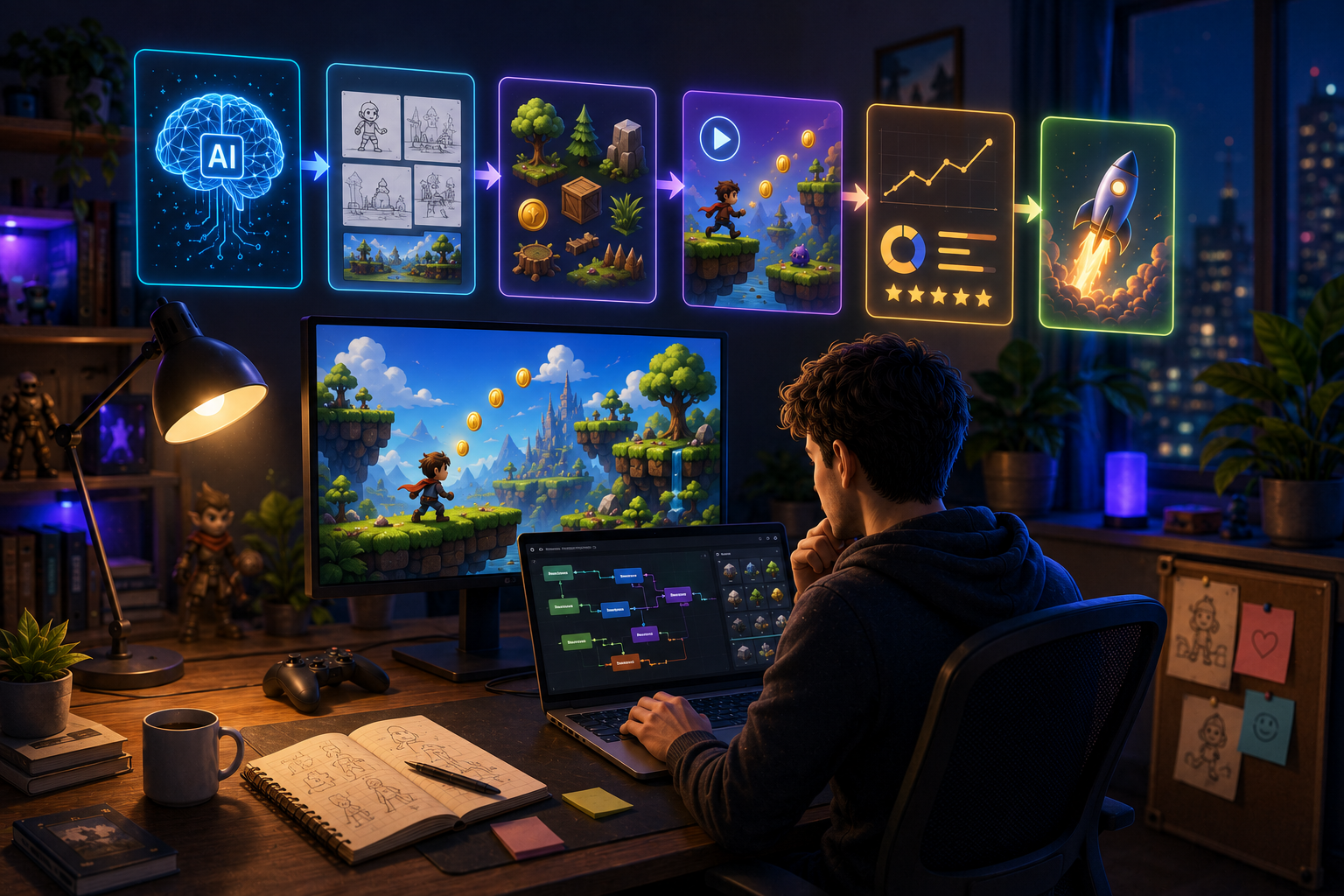
How AI Is Helping Independent Game Developers Succeed
Independent developers have always faced the same structural disadvantage against larger studios: fewer people, smaller budgets, and less time to test as many ideas before committing to one. AI hasn’t erased that gap entirely, but it has changed which parts of it actually matter, and independent developers who understand that shift are finding real, measurable success because of it.
The Traditional Disadvantage Independent Developers Faced
Fewer Hands Meant Less Output
A studio with dozens of employees could produce more content, test more variations, and polish more thoroughly simply because more people were working in parallel. An independent developer working alone or in a small team had no way to match that pace, regardless of talent or dedication.
Limited Budget Meant Limited Iteration
Testing multiple directions before committing to one requires time and resources. Independent developers historically had to commit earlier and with less certainty, since building several full prototypes wasn’t financially realistic the way it might be for a better-funded studio.
Smaller Reach Made Every Release Higher Stakes
With fewer releases possible overall, each one carried more weight. A single underperforming launch could set an independent developer back significantly longer than it would a studio with the resources to absorb a miss and move on to the next project.
Where AI Has Genuinely Shifted the Balance
Prototyping Speed Levels the Early-Stage Playing Field
Game maker online platforms let an independent developer test an idea in hours instead of weeks. That speed matters disproportionately for smaller teams, since it means testing multiple directions before committing is now realistic even without a large team or budget behind the effort.
Asset Production No Longer Requires a Full Team
Visual and audio production used to scale closely with team size, which put independent developers at a structural disadvantage regardless of how strong their design instincts were. AI-assisted asset generation narrows that gap considerably, letting a single developer produce content that would have previously required a dedicated art department.
Faster Iteration Compounds Over an Entire Project
Games like Global Conquest reflect what sustained, fast iteration can produce for an independent developer, a deep strategic system that likely benefited from many rounds of testing and refinement rather than a single, carefully guessed initial design. That kind of depth used to require far more time and often a larger team than a project like this would suggest.
How Independent Developers Are Actually Using These Tools
Validating Ideas Before Committing Serious Time
Rather than betting months of work on an unproven concept, independent developers increasingly build a rough, testable version first and validate whether it’s genuinely fun before investing further. This reduces the risk that used to make each project such a high-stakes decision.
Competing on Polish Instead of Volume
Since AI-assisted tools handle a larger share of repetitive implementation work, independent developers can redirect saved time toward polish, tightening feel, refining pacing, smoothing feedback, areas where a small, focused team can genuinely compete with, or even outperform, a larger studio spreading its attention across more simultaneous projects.
Publishing More Frequently With Lower Risk Per Release
Faster development means independent developers can ship more often, which spreads risk across more releases instead of concentrating it into a single high-stakes launch. A string of smaller, well-tested releases tends to build sustainable momentum in a way that betting everything on one large project rarely does.
What Success Actually Looks Like for Independent Developers Now
Sustainable Output Instead of Boom-or-Bust Cycles
Where independent development used to mean long stretches of invisible work followed by a single high-stakes release, faster iteration allows for a steadier rhythm of smaller releases, each one informed by lessons from the last. That sustainability matters enormously for developers trying to build a long-term practice rather than gambling on a single breakout hit.
Differentiation Through Design, Not Production Value
As the technical execution gap narrows, what actually separates a successful independent developer from an unsuccessful one increasingly comes down to design sensibility and originality rather than who could afford the biggest team. That shift favors independent developers specifically, since design instinct was rarely the thing holding them back in the first place.
Direct Relationships With Players
Independent developers publishing more frequently and iterating based on real feedback tend to build closer, more responsive relationships with their player base than larger studios operating on longer release cycles. That direct connection often becomes a genuine competitive advantage over time.
What Still Depends Entirely on the Developer
Creative Vision and Direction
AI accelerates execution, it doesn’t generate the underlying reason a game is worth making. Independent developers still need a genuine creative vision, the thing that gives their work an identity distinct from anyone else using the same tools.
Honest Self-Evaluation
Faster iteration only helps if it’s paired with honest assessment of what’s actually working. Independent developers still need to playtest rigorously and be willing to abandon ideas that aren’t landing, regardless of how quickly they were produced.
Building and Maintaining an Audience
Technology hasn’t automated the relationship-building that turns a released game into a sustainable practice. Independent developers still need to engage with their community, respond to feedback, and build the kind of trust that brings players back for future releases.
A Practical Approach for Independent Developers
- Validate ideas fast before committing serious time to any single one.
- Use saved implementation time for polish, not just additional content.
- Publish more frequently with smaller, well-tested releases.
- Build direct relationships with players and iterate based on their feedback.
- Keep design judgment and creative vision as your primary differentiator.
Final Thoughts
AI is helping independent game developers succeed not by replacing the creativity and persistence that independent development has always required, but by narrowing the structural gap that used to separate a solo creator from a full studio. Prototyping is faster, asset production is more accessible, and iteration happens at a pace that used to be reserved for teams with far more resources.
What still determines whether an independent developer actually succeeds is the same as it’s always been: a genuine creative vision, honest iteration, and the discipline to keep refining based on real player feedback. AI has just made it realistic to act on those strengths without a large budget standing in the way.