Why User-Generated Discussions Still Matter in the Social Media Era?
Social media has made it easier than ever to publish something and reach other people.
A thought can become a post in seconds. A question can receive responses from people thousands of miles away. Someone looking for advice can find others who have dealt with a similar situation. A niche interest can bring together people who might never have met offline.
Yet despite the enormous growth of mainstream social networks, there is still something valuable about spaces built around conversations.
An online discussion forum gives people an opportunity to do more than present themselves or scroll through a stream of updates. It creates room for questions, opinions, experiences, disagreements and detailed exchanges between users.
That distinction matters because social interaction is not always about collecting followers or creating polished content.
Sometimes people simply want to talk about something.
They want to ask, “Has anyone else experienced this?”
They want to explain what they think.
They want to hear another perspective.
Or they want to discover a conversation that they never expected to find.
Social Media Has Become More Than Personal Profiles
Many social networks originally placed considerable emphasis on individual profiles.
Users followed friends, shared photographs and posted updates about their lives. The profile became a central representation of the person.
That model remains popular, but online interaction has expanded considerably.
People now participate in conversations around interests, events, questions and opinions that may have little connection to their personal identity.
Someone can be deeply interested in a subject without wanting to build an entire online persona around it.
That is where discussion-centered experiences become useful.
The subject of the conversation can become more important than the person who started it.
User-Generated Content Changes the Conversation
Professionally produced content has an important place online.
News organizations publish reports. Companies create educational resources. Experts produce articles and videos.
But ordinary users also have something valuable to contribute: their experiences.
A person who has used a product for several years may have practical knowledge that does not appear in promotional material.
Someone who has traveled to a particular location can explain what the experience was actually like.
A hobbyist may know details that a general article overlooks.
A user who has faced a problem may ask a question that helps dozens of other people with the same issue.
This is the strength of user-generated discussion.
The content comes from people participating in the subject rather than simply consuming it.
Questions Are One of the Most Valuable Forms of Content
Not every useful online contribution needs to be a long article.
Sometimes the most useful post is a simple question.
“How did you solve this?”
“Which option worked better for you?”
“What would you do differently?”
“Has anyone experienced the same problem?”
These questions create opportunities for others to contribute.
A single question can produce multiple answers, follow-up questions and personal stories.
The original poster may receive practical information, while other readers discover solutions they had not considered.
The discussion becomes useful to more people than the person who started it.
Personal Experiences Add Something Different
People often search for information before making decisions.
They may be researching a service, considering a purchase, planning a trip, choosing a hobby or dealing with an unfamiliar situation.
Professional information can explain the basics.
Personal experiences can explain what those basics look like in real life.
Someone might explain what surprised them.
Another person may describe a mistake they made.
Someone else may share a solution that worked in an unusual situation.
These experiences are subjective, but that does not make them worthless.
Readers can compare several accounts and identify patterns.
Niche Subjects Need Community Participation
The internet is full of specialized interests.
Some subjects attract millions of people.
Others may appeal to only a few thousand.
Traditional media may not have enough reason to cover every niche topic in detail.
Online communities can fill that gap.
A small group of enthusiasts can create an ongoing conversation about a subject that receives very little mainstream attention.
This can include hobbies, technical questions, unusual interests, local experiences or specialized professional topics.
The value comes from people who are genuinely interested in the subject contributing their own knowledge.
Different Viewpoints Make Discussions More Interesting
A discussion where everyone agrees may be pleasant, but disagreement can make a conversation more informative.
Two people can look at the same issue and reach completely different conclusions.
One may prioritize convenience.
Another may prioritize cost.
A third may care more about long-term consequences.
When people explain those differences, readers gain a broader understanding of the subject.
Disagreement can therefore be productive when participants focus on ideas rather than attacking one another.
The goal does not have to be reaching a unanimous conclusion.
Sometimes the value lies in seeing how different people think.
Social Media Feeds Can Encourage Passive Consumption
Modern social platforms are highly optimized for continuous browsing.
A user sees one post, scrolls, sees another, scrolls again and repeats the process.
This can be entertaining, but it can also encourage passive consumption.
Discussion-centered spaces offer a different experience.
Instead of constantly asking, “What is next?” users can focus on a particular subject.
They can read a conversation, decide whether they have something to contribute and return later to see how others responded.
The pace becomes less about endless discovery and more about participation.
Starting a Conversation Gives Users More Control
One important difference between user-generated discussions and traditional feeds is that users can initiate the subject.
They do not have to wait for an organization or influencer to publish something they care about.
They can ask their own questions.
They can describe an experience.
They can present an opinion.
They can start a debate.
This gives ordinary users more control over what gets discussed.
The community determines which conversations attract attention.
That can create a more varied environment than one built entirely around professionally selected content.
Voting Can Help Communities Surface Interesting Discussions
Many discussion platforms use some form of voting or reaction system.
Voting can help users signal that a post or comment is useful, interesting or worth reading.
It does not guarantee that the most popular contribution is the most accurate one.
Popularity and correctness are different things.
Still, community feedback can help readers navigate large amounts of user-generated material.
A thoughtful explanation may receive positive responses because several people found it useful.
A question may gain attention because many readers have the same problem.
The voting system becomes another form of community participation.
Following Discussions Creates Continuity
A single post can be useful, but ongoing discussions create something different.
People can return after receiving answers.
They can update the original question.
They can respond to new information.
Other users can continue the conversation.
This continuity is particularly valuable for subjects that develop over time.
A question about a new product, changing policy or ongoing event can evolve as participants learn more.
The discussion becomes a living record of the community’s experiences and reactions.
Community Knowledge Can Accumulate
One of the most interesting characteristics of user-generated discussions is that useful information can accumulate gradually.
The first person asks a question.
Someone provides an answer.
Another user adds an alternative.
A third explains a problem with the first suggestion.
Someone else shares a personal experience.
Over time, the conversation can become much more detailed than the original question.
This process is difficult to replicate through a single static article.
The knowledge comes from participation.
Online Communities Can Make People Feel Less Alone
There is also a social and emotional dimension to discussion spaces.
People sometimes experience situations they believe nobody else understands.
Finding others who have experienced something similar can be reassuring.
A person might describe a challenge and receive responses from people who have faced something comparable.
The discussion does not necessarily solve the problem.
But knowing that others have dealt with something similar can still be meaningful.
Community participation can create a sense of connection around shared experiences.
Anonymity Can Encourage More Open Participation
Not everyone wants every online conversation connected closely to their real-world identity.
Depending on the platform and its policies, users may have different levels of anonymity or privacy.
That can make it easier to discuss subjects that people might hesitate to raise publicly under their full identity.
However, anonymity can have both positive and negative consequences.
It may encourage honesty and openness, but it can also reduce accountability.
Strong community environments therefore need reasonable standards for respectful participation.
The goal is to make people comfortable contributing without allowing anonymity to become an excuse for harmful behavior.
Discussion Is Different From Professional Publishing
User-generated content should not be confused with professional editorial content.
A community member is not necessarily a journalist, researcher or subject-matter expert.
Their contribution may reflect personal experience rather than verified information.
That distinction matters.
A user sharing what happened to them is valuable as an experience.
It should not automatically be treated as universal evidence.
Readers benefit when they consider multiple contributions and verify important claims when necessary.
The strength of user-generated discussion is variety, not guaranteed authority.
Why Ordinary Opinions Can Still Be Valuable
An opinion does not need to come from a famous person to be interesting.
Someone who has thought carefully about a subject may have a useful perspective regardless of their online following.
A community discussion gives ordinary users a chance to contribute those perspectives.
One person may notice an issue that others overlooked.
Another may explain why a popular assumption does not match their experience.
Someone else may offer a practical alternative.
This diversity is one reason community-created content remains relevant despite the growth of influencer-driven social media.
Discovering People Through What They Discuss
Traditional social networking often begins with the person.
You find someone, view their profile and decide whether you want to follow them.
Discussion-centered platforms can reverse that process.
You discover a conversation first.
Then you notice the people participating in it.
You may find someone whose opinions interest you, whose experiences are similar to yours or whose expertise adds something useful.
The relationship develops from participation.
That can create a different kind of social discovery.
You are not simply following a profile.
You are discovering someone through what they contribute.
Conflingo’s User-Generated Discussion Space
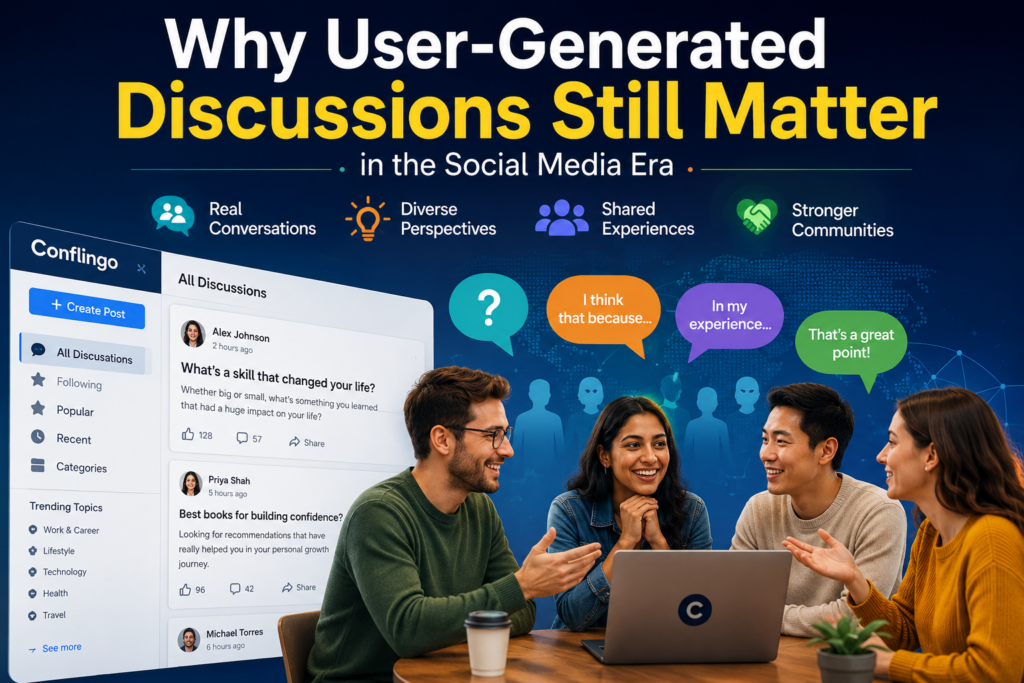
Conflingo is a broader social media platform centered around conversations, opinions, shared interests and interaction between users.
Its online discussion forum represents the user-generated discussion side of that wider platform.
This distinction is important.
Conflingo itself should not be reduced to a traditional forum. The platform also includes social profiles, interactive features, news, matching, points and other ways for users to interact.
The all opinions section focuses specifically on community-created conversations, where users can create posts and contribute through comments, voting and discussion.
That makes it a useful example of how a social media platform can give ordinary users space to create the subjects they want to discuss.
Why Starting Your Own Post Matters
There is a major difference between commenting on someone else’s subject and starting your own.
When you create a post, you decide what question or idea deserves attention.
Perhaps you have an unusual experience you want to share.
Maybe you are looking for advice.
You might have an opinion about a current issue.
Or perhaps you simply want to know whether other people think the same way.
Starting the conversation gives the community an opportunity to respond.
The result can be something the original poster could never have created alone.
The Value of Direct Responses
Discussion works because people can respond directly.
A user can answer a question.
Another can challenge the answer.
The original poster can clarify what they meant.
Someone else can introduce a completely different perspective.
This creates a chain of interaction.
A traditional article generally has a fixed structure.
A conversation can change direction based on what participants contribute.
That flexibility is one of the reasons discussions remain useful.
Advice Becomes More Valuable When Experiences Are Shared
Advice is everywhere online, but not all advice is equally useful.
A generic recommendation may not account for the details of someone’s situation.
A discussion can allow the person asking for help to explain those details.
Other users can then respond based on their own experiences.
The original poster can ask follow-up questions.
Someone can suggest an alternative.
Another person can explain why a particular approach did not work for them.
This back-and-forth makes community advice more adaptable.
Discussions Can Preserve Different Opinions
Not every conversation needs to produce a single answer.
Some questions are subjective.
Which approach is better?
Which option offers the best value?
What would you choose?
How should someone handle a particular situation?
Different users may reach different conclusions.
That is not necessarily a weakness.
Seeing multiple viewpoints can be more useful than receiving one definitive answer, particularly when the subject involves personal preferences or circumstances.
Community Participation Creates Ownership
A community becomes more meaningful when users feel that they contribute to it rather than simply consume it.
Posting, commenting, voting and responding all create participation.
Over time, those individual actions shape the character of the community.
The topics people choose to discuss influence what future visitors discover.
The quality of responses influences whether people return.
The willingness of members to answer questions affects how useful the environment becomes.
The community is therefore shaped by its users.
Why User-Generated Discussions Still Have a Place
The growth of short-form video, influencers and algorithmic feeds has not eliminated the need for discussion.
If anything, the abundance of passive content makes focused conversation more noticeable.
People still have questions.
They still want advice.
They still have experiences to share.
They still disagree.
They still want to find people interested in the same subjects.
A discussion space gives those needs somewhere to go.
It allows the user to become part of the content rather than remaining only an audience member.
Building a Healthy Discussion Culture
The usefulness of a community depends heavily on how people behave within it.
Good discussions benefit from several simple principles.
Respond to the idea, not the person.
Explain your reasoning when disagreeing.
Acknowledge when another user has a valid point.
Avoid presenting personal experience as universal truth.
Verify important claims.
Ask questions when information is unclear.
These habits do not eliminate disagreement.
They make disagreement more useful.
The Future of Community-Created Content
Social media will continue changing.
New formats will appear.
Algorithms will become more sophisticated.
Video and visual content will remain important.
But the basic human desire to talk with other people about subjects that matter is unlikely to disappear.
The technology may change.
The conversation remains.
Platforms that give users meaningful ways to start discussions, respond to others and discover people through shared interests can continue to serve an important role alongside more entertainment-focused social networks.
Final Thoughts
User-generated discussion spaces remain valuable because they give ordinary people something that polished feeds cannot always provide: the opportunity to shape the conversation themselves.
They can ask questions, share personal experiences, discuss niche subjects, offer advice, disagree with others and explain their opinions.
An online discussion forum is valuable not simply because it contains posts, but because those posts become starting points for interaction.
Conflingo demonstrates how this model can exist within a broader social media platform. It focuses on community-created posts, comments, voting and discussions across different subjects, while the wider platform extends beyond forums into other forms of social interaction.
That distinction matters.
The future of social media does not have to be entirely about profiles, followers and endless scrolling.
There is still room for people to ask a question and wait for an answer.
There is room for someone to say, “This was my experience.”
There is room for disagreement.
There is room for curiosity.
And there is still plenty of value in giving ordinary users the ability to start a conversation and see where it goes.