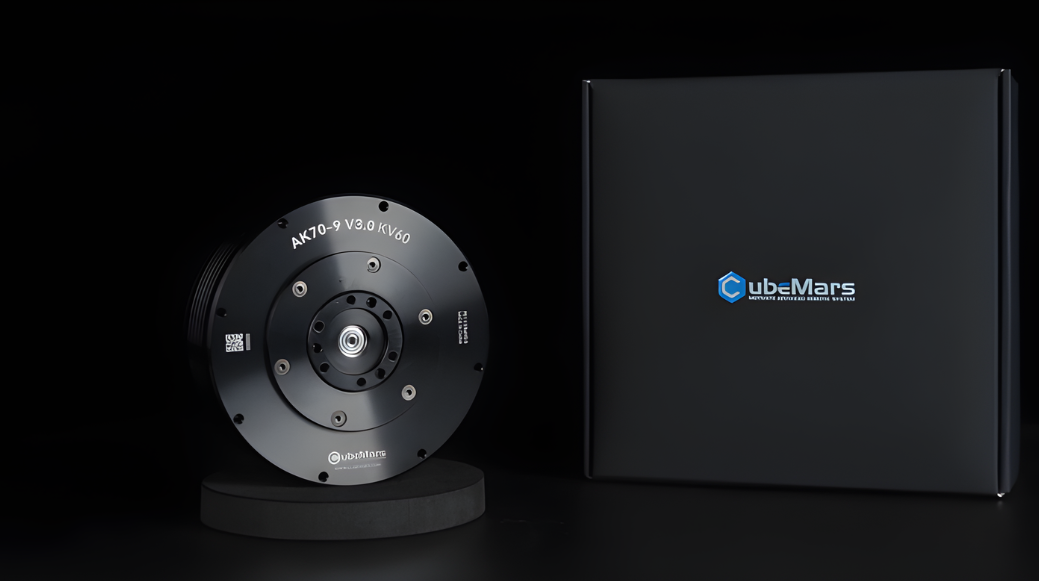
Simplify Robot Joint Design with an Integrated Humanoid Robot Motor
Today’s humanoid robots are expected to accomplish ever more complicated tasks ranging from walking on uneven surfaces to handling fragile items with precision. The efficiency of all the joints in the robotic system is crucial to achieving these capabilities. Multiple parts are often needed to assemble a traditional joint assembly, adding to the design complexity, wiring, and maintenance. Integrated motor solutions make this easier—essential elements are built into a single package, and engineers can concentrate more on robot performance and less on mechanical integration.
1.Why Integrated Joint Systems Are Changing Humanoid Robotics
Humanoid robots use coordinated motion of their joints to simulate human movement. All shoulders, elbows, hips, knees, wrists and ankles should produce precise torque with stable, repeatable motion. If each of the various independent parts—motors, gearboxes, encoders, controllers and the like—is designed separately, the system is more complex and difficult to design and maintain.
Integrated joint systems are a solution to this challenge, because they integrate these key elements into one actuator module. Rather than investing a lot of time finding compatible components, engineers are provided with a compact solution that functions as a complete system.
This approach provides several important advantages:
Benefits of Integrated Joint Designs
- Fewer mechanical components simplify assembly.
- Compact construction reduces overall robot size.
- Lower wiring complexity improves reliability.
- Factory-integrated components minimize installation errors.
- Easier maintenance supports long-term operation.
Integrated joint modules minimize the mechanical complexity of the robot, enabling robotic developers to speed up development and ensure uniform motion quality across the robot.
2.The Importance of Torque Density and Lightweight Construction
Each kilogram added to a humanoid robot has an impact on its energy use, agility and balance. Heavy joints require a greater amount of power to move, which means more power is needed and less efficiency in the operation.
Modern robotic actuators are thus designed to provide high torque density, which implies that they are able to deliver high force with a relatively small and light design. This balance is particularly crucial for robots engaged in dynamic operations like walking, climbing, jumping, or transporting objects.
Manufacturers like CubeMars have invested in the design and development of integrated actuator modules that integrate the brushless DC motors, planetary gearboxes, precision encoders, and built-in drives into lightweight packages. This integrated architecture allows us to minimize the unnecessary mass without compromising the output performance.
Lighter joints also enhance responsiveness, as there is less inertia to deal with when accelerating and decelerating. This means that humanoid robots will be able to make smoother movements and use less energy.
3.Humanoid Robot Motor Solutions for Precision Motion
The Humanoid Robot Motor performance directly affects the natural movement of a robot. Each joint has to carry out instructions correctly while adjusting to fluctuating loads, speeds and constant movement cycles.
Modern integrated humanoid actuators develop a solution to these requirements by integrating several technologies into one small module. These motors include precision hardware, eliminating the need for external controllers and sensing devices for stable and responsive operation.
Several key features contribute to precise joint performance:
Core Features Supporting Accurate Motion
- Integrated brushless DC motor and planetary gearbox.
- High-precision dual encoder feedback for accurate positioning.
- Servo and MIT control mode compatibility.
- Built-in protection against overheating and voltage abnormalities.
- Adaptive parameter identification for simplified commissioning.
These built-in features contribute to stable gait control, coordinated arm movements, and enhanced balance during dynamic activities. The position of the joint is monitored continuously by high-resolution encoder feedback, which makes it possible to make accurate adjustments while moving.
Various actuator configurations also support various sections of a humanoid robot. Compact actuator models are ideal for wrist and upper limb applications, where lightweight construction and fast response are of paramount importance. The higher gear reduction and higher torque output of larger actuator modules are able to support body weight with the hips, knees, and other lower limb joints.
Some of the more advanced actuator modules also have hollow-shaft designs for added integration. Internal cable routing minimizes external wiring and simplifies mechanical design, especially for robots with multiple interconnected joints.
4.Intelligent Control Makes Joint Design More Efficient
Not all hardware is effective in robotic motion. Advanced control features are also essential for providing smooth and repeatable operation.
Modern integrated actuators offer multiple control modes such as position control, speed control, torque control, and hybrid motion control. This versatility enables the optimization of performance for various robotic tasks without the need to replace hardware.
Adaptive parameter identification also eases system configuration. Embedded Controllers automatically detect appropriate parameters to ensure consistent operation across multiple actuators and minimize set-up time, eliminating the need for extensive manual tuning.
The other benefit is the monitoring of the operating conditions that can be done continuously. Inbuilt protection mechanisms provide protection against overcurrent, voltage abnormalities, or overheating before these problems impact system stability. This helps to ensure reliable performance for challenging robotic applications.
These smart control functions simplify the engineering process in research labs, education, industrial automation or service robotics while ensuring accurate joint operation.
5.Robot Joint Motor Design Considerations for Different Robot Sections
Each Robot Joint Motor has a unique function based on its position in the humanoid robot. The lower limb joints need a lot more torque to hold the body up and be stable, whereas the upper limb joints need to be more responsive and have more precise positioning.
So choosing the right type of actuator relies on mechanical needs and desired movement attributes.
Upper limb actuators are typically developed to deliver rapid response, small size, and precise motion for various applications such as shoulder rotation, elbow articulation and wrist motion. Moderate gear ratios ensure an optimum balance of speed and torque for these functions with integrated modules.
In contrast, lower limb actuators are often equipped with higher gear ratios to produce higher torque when walking, squatting, climbing or lifting. During dynamic movement, high-torque actuator modules help robots to keep a stable posture when handling variable loads.
Another benefit of hollow planetary actuator modules is the practicality of routing the internal cable through the actuator. This minimizes cable exposure, simplifies joint layout, and enhances the reliability of robots with many interconnected joints.
Actuators with integrated motors, encoders, gearboxes and drive electronics simplify robot assembly and standardize the robot architecture, regardless of the joint location.
Regardless of joint location, selecting actuators with integrated motors, encoders, gearboxes, and drive electronics helps standardize robot architecture while reducing assembly complexity.
6.Integration Improves Reliability Across Complex Robotic Systems
The more sophisticated humanoid robots are, the more joints are active. More joints, more cables, more connectors, more controllers, more calibration – that’s the old rule.
Integrated actuator modules overcome these challenges to a large extent by integrating several functions into one housing.
This simple design can enhance system reliability in a number of ways. The fewer external connections, the less the potential number of failure points and the more compact the mechanical layout, the easier the maintenance and inspection. Integrated encoder feedback guarantees accurate position detection during operation, even with prolonged use.
Some of the higher-level actuator modules also have a second communication interface for daisy-chaining multiple joints. This enables a decrease in wiring complexity and enhances communication efficiency between actuators.
Since integrated solutions are designed as a package, and not a variety of stand-alone parts, compatibility problems are reduced, which results in more reliable robotic performance.
Conclusion
The first step to simplifying the design of a robot’s joints is to eliminate superfluous mechanical and electrical complexity. Integrated actuator modules combine motors, gearboxes, encoders and drive systems in a compact unit to save time during installation, increase motion precision, and provide long-term reliability. They are lightweight, smartly controlled and have high torque density, which makes them appropriate for the complex motions of today’s humanoid robots. Integrated joint solutions will continue to serve as a solid basis for the development of agile, accurate and reliable humanoid systems in various applications such as research, automation, medical and service.