ENM Terms Explained: Compersion, Metamour, NRE and the Language of Ethical Non-Monogamy
People who look up ethical non-monogamy hit a second wall almost immediately: a set of words like compersion, metamour, and NRE that no standard dictionary explains well. These terms exist because everyday relationship language has no name for what non-monogamous people go through. This guide defines the words you will actually hear, shows where they came from, and gives a sense of how common the practice really is.
Where the vocabulary came from
Most ENM language grew out of community writing rather than academic research. The Ethical Slut by Dossie Easton and Janet Hardy, first published in 1997, shaped a large part of it, and More Than Two by Franklin Veaux and Eve Rickert added to it in 2014. Compersion itself was reportedly coined inside a San Francisco community in the 1990s.
Knowing the source matters. These are descriptive words that communities agreed on over time, so the same term can shift slightly between groups. Treat each one as shorthand for a conversation, not a fixed rule.
How common is it?
Studies indexed in relationship research estimate that roughly 4–5% of people are in a consensually non-monogamous relationship at any given time. Research also finds no meaningful difference in relationship satisfaction between monogamous and non-monogamous couples. Figures move around depending on the sample, so read them as a range rather than a fixed statistic.
Feelings people give a name to
Compersion — Joy you feel at a partner’s happiness with someone else. It is often described as the counterpart to jealousy, but you do not need to feel it to practise ENM well. Respect and honesty matter more than reaching for a specific emotion.
New Relationship Energy (NRE) — The intense excitement of an early connection. Naming it helps, because it fades and can quietly pull attention away from established partners while it lasts.
Established Relationship Energy (ERE) — The steady, settled warmth of a long-term bond, built on familiarity rather than novelty.
Limerence — An obsessive, involuntary infatuation that people sometimes mistake for love. It shares the intensity of NRE but with a more consuming edge.
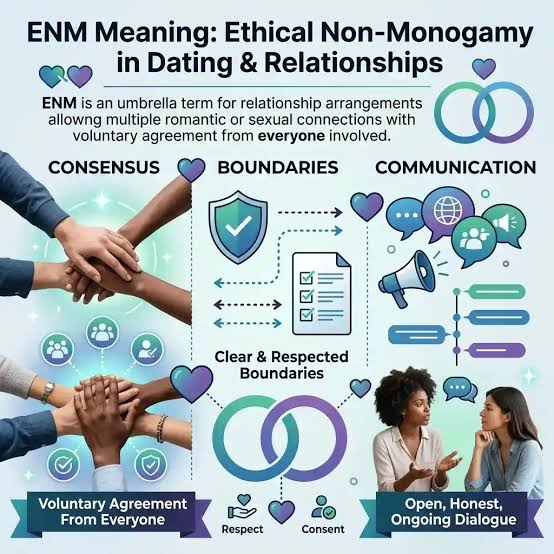
These feelings sit underneath every structure, so if you are still sorting out the basics first, the full ENM meaning page covers the definition, dating-profile use, and consent before you go deeper into the vocabulary here.
People and roles
- Metamour — Your partner’s other partner. You are connected through a shared partner, not by dating them yourself. Often shortened to meta. These relationships range from close friendship to polite distance.
- Nesting partner — A partner you live with. The term separates cohabitation from ranking, so living together does not automatically signal “primary” status.
- Anchor partner — A partner who provides stability and consistency through deep trust, without implying a hierarchical label.
- Comet partner — A recurring but infrequent partner who reappears over time, like a comet passing through.
- Hinge — The shared person who connects two people who are not involved with each other.
- Unicorn — Usually a single bisexual person a couple hopes to add. Unicorn hunting describes couples searching for one, and many criticise the practice for treating that third person as an accessory to an existing couple rather than an equal.
How networks are described
- Polycule — The full connected network of partners and metamours linked through their relationships. It can be open or closed and contain any number of people.
- Kitchen table polyamory (KTP) — Everyone in the network is comfortable enough to share a meal together. It emphasises integration and community.
- Parallel polyamory — Partners keep their relationships separate and rarely interact.
- Garden party — A middle ground: people are friendly at shared events but do not build close ties.
- Polysaturated — At capacity, with no bandwidth for another partner right now.
Agreement words that cause confusion
DADT (don’t ask, don’t tell) — Partners agree not to share details about outside connections. It can protect privacy, but it can also hide information that affects someone’s ability to consent, so it works only when everyone genuinely wants it.
Veto — An arrangement where one partner can end another partner’s relationship. Many people reject it because it creates instability and a power imbalance, and prefer clear personal boundaries instead.
Couple privilege — The built-in advantages an established couple holds over newer partners, from shared history to social recognition. Naming it helps couples avoid treating a new person as disposable.
Using these words well
Language in ENM is descriptive, not prescriptive. The same word can mean slightly different things from one community to the next, and that is normal. When a term comes up, define it with the person in front of you rather than assuming you both mean the same thing.
A label names a pattern; it does not settle questions about commitment, time, privacy, or sex. The vocabulary earns its value when it makes a real conversation easier, not when it replaces one.
Quick reference
| Term | Short meaning |
| Compersion | Joy at a partner’s joy with another person |
| NRE | Excitement of a new connection |
| ERE | Steady feeling of a long-term bond |
| Limerence | Obsessive early infatuation |
| Metamour | Your partner’s other partner |
| Nesting partner | A partner you live with |
| Anchor partner | A stable, grounding partner |
| Comet partner | A recurring, infrequent partner |
| Hinge | The shared link between two unconnected people |
| Unicorn | A single person a couple seeks to add |
| Polycule | The whole connected relationship network |
| KTP | Network where everyone shares a meal comfortably |
| Parallel | Partners stay separate and rarely interact |
| Polysaturated | At capacity for partners |
| DADT | Agreement not to share outside-relationship details |
| Veto | One partner can end another’s relationship |
Sources
Terminology varies across people and communities, so ask how someone uses a word rather than assuming. Definitions here reflect community glossaries and relationship research, including work associated with The Ethical Slut, More Than Two, and the APA Division 44 consensual non-monogamy fact sheet. This material is educational, not therapeutic advice.