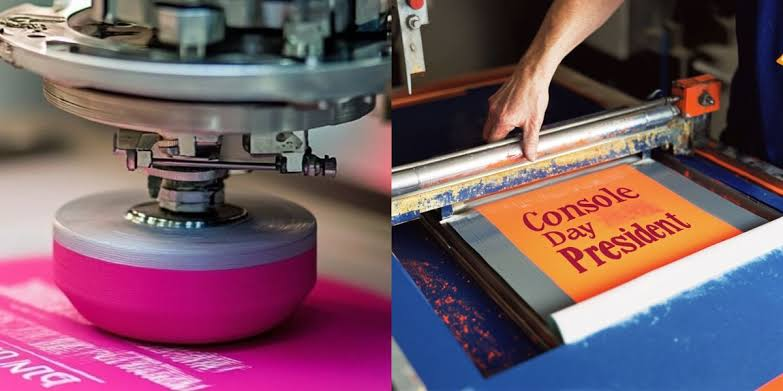
Screen Printing vs Pad Printing for Industrial Product Decoration
Industrial product decoration is no longer just about putting a logo or label on a product. Manufacturers need markings that look professional, remain legible through regular use, and fit efficiently into high-volume production. Choosing the right printing method can therefore have a direct impact on product quality, production speed, and overall manufacturing costs.
Two of the most established techniques are screen printing and pad printing. Although both can produce durable graphics and text, they are designed for different applications. The best choice depends on the product’s shape, surface, artwork, material, production volume, and required finish.
Understanding the differences between these processes helps manufacturers select a decoration method that delivers consistent results without adding unnecessary complexity to the production line.
How Screen Printing Works
Screen printing uses a mesh screen to transfer ink onto a product through a prepared stencil. The areas that should remain unprinted are blocked, while a squeegee pushes ink through the open sections of the mesh and onto the surface.
One of the major advantages of screen printing is its ability to deposit a relatively substantial layer of ink. This can create strong, vibrant graphics with good opacity, making the process particularly useful when decoration needs to remain highly visible.
Screen printing is well suited to relatively flat or gently curved surfaces. It can be used for industrial panels, containers, signage, promotional products, and components where larger graphics or bold markings are required.
For manufacturers considering modern automated equipment, solutions from Screen Printing can help integrate consistent printing into demanding production environments.
Where Pad Printing Has the Advantage
Pad printing works differently. Instead of transferring ink directly through a screen onto the product, the image is first etched into a printing plate. A silicone pad then picks up the ink and transfers it onto the target surface.
The flexibility of the silicone pad is one of the technology’s biggest strengths. It can conform to irregular, rounded, textured, or recessed surfaces that would be difficult to decorate using conventional screen printing.
This makes pad printing particularly valuable for small industrial components, molded plastic parts, electronic controls, medical devices, bottle caps, and products with complex geometries.
Pad printing can also handle relatively small artwork and detailed markings effectively. When the decoration area is limited or positioned on a difficult surface, its flexibility can make it the more practical solution.
Comparing Print Quality and Durability
Both technologies can produce durable industrial markings, but their performance depends heavily on ink selection, surface preparation, curing, and the intended environment.
Screen printing is often preferred when bold, highly visible graphics are required. Its thicker ink deposit can provide strong coverage and vibrant colors, especially on suitable flat substrates. It can also be an efficient choice when manufacturers need larger printed areas.
Pad printing offers excellent control for small graphics and detailed images. Because the silicone pad can adapt to the product’s shape, it can maintain accurate decoration across surfaces that are not perfectly flat.
For either process, durability should be evaluated against real operating conditions. Exposure to chemicals, abrasion, heat, moisture, and frequent handling can influence ink performance. Testing the complete printing system on the actual production material is therefore an important step before large-scale manufacturing.
Production Speed, Volume, and Cost
Production requirements can strongly influence the decision between screen and pad printing. In high-volume manufacturing, automation, repeatability, setup time, and cycle time all matter.
Screen printing can be highly productive when products have consistent surfaces and the same graphic is applied repeatedly. Automated systems can help reduce manual handling while maintaining registration and print consistency.
Pad printing can also be automated and is particularly valuable where product geometry makes conventional printing difficult. However, the overall process may involve additional considerations such as specialized plates, pads, fixtures, and artwork setup.
Cost should therefore not be judged simply by the price of the machine. Manufacturers should consider the complete production process, including consumables, labor, setup, maintenance, rejects, and cycle time. A slightly more specialized solution may ultimately provide better value if it reduces defects and simplifies production.
Which Printing Method Should Manufacturers Choose?
There is no universal winner between screen printing and pad printing. The right option depends on the product and the decoration requirements.
Screen printing is generally a strong choice for flat or moderately curved surfaces, larger graphics, bold branding, and applications where substantial ink coverage is desirable. Pad printing becomes more attractive when products contain curves, recesses, uneven surfaces, or small areas that require precise decoration.
Manufacturers should also consider the substrate, ink chemistry, artwork complexity, number of colors, production volume, curing requirements, and expected durability before making a decision.
In some production environments, the two technologies can even complement one another rather than compete. Different product components may require different decoration methods, allowing manufacturers to select the most efficient process for each part.
Conclusion
Screen printing and pad printing remain valuable technologies for industrial product decoration because they solve different manufacturing challenges. Screen printing excels when strong coverage, bold graphics, and efficient decoration of suitable surfaces are priorities. Pad printing stands out when precision and flexibility are needed on small, curved, recessed, or irregular components.
The most effective approach is to evaluate the entire application rather than choosing a process based solely on equipment cost or familiarity. By matching the printing technology to the product geometry, material, artwork, production volume, and durability requirements, manufacturers can improve consistency while controlling long-term production costs.
As industrial manufacturing continues to emphasize automation and repeatable quality, selecting the right printing process will remain an important part of building an efficient and dependable decoration workflow.